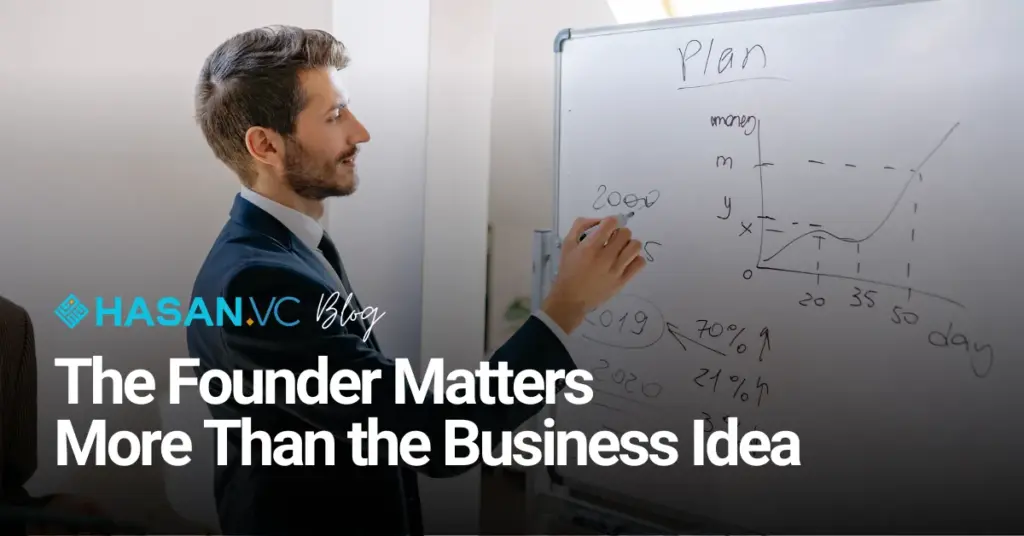
A compelling idea can attract capital. Converting that capital into durable enterprise value is a different task entirely, and this falls on the founder – the entrepreneur who started the startup, and typically also its leader and CEO. Today, there are even one-person startups supported by AI. Whether its one person or a team of co-founders, the founders make operating decisions when their startup theses meet reality.
This distinction matters more today than it did five years ago. Venture capital is now operating in a higher-cost-of-capital environment, and a highly volatile world fraught with risk. VCs are more selective, and capital is harder to come by. At the same time, AI has reduced the cost of tech development and operations in general – a lot less money is now needed to launch a startup. Adaptability, capital efficiency, and operational discipline have become high-value signals to investors.
Capital allocators are demanding unit-economic viability, cash-flow resilience, and downside protection earlier in a startup’s journey. Speculative, hype-driven businesses without a clear monetization path are finding it harder to secure funding. This is true globally, except maybe in financial and tech centres with a high concentration or VCs or strong government support. For the emerging world and the Muslim world, this is the default scenario for founders.
The investment environment now rewards founders who can operate through capital scarcity, not those who need to rely on capital abundance.
For investors, the practical implication is this: evaluate the person capable of driving the business, not just the business as a compelling concept.
The Institutional Evidence: VCs Bet on the Founder
Institutional venture research has documented this pattern directly.
In a survey of 885 institutional venture capitalists across 681 firms conducted in the US (the majority of VC and startup data available is from the US), 95% of VC firms identified the founding team as an important factor in investment selection. 47% ranked the founding team as the single most important factor, compared with 37% for business-related factors.
At the same time the underlying finding is that business stability was surprisingly high in their sample, while founding team turnover was substantial. This creates a potential counterpoint to the founder-first argument: the business itself can remain relatively stable even as the people running it change.
This is often framed as the “Horse vs Jockey” debate – is it the horse or is it the rider who brings victory in a race?
- Evidence for the Jockey view: This survey’s data points to investors weighting the operator’s ability to identify, adapt to, and execute against a moving target.
- Evidence for the Horse view: Another research paper tracking 50 venture-capital backed startups from business plan through IPO, found that business lines remained remarkably stable while management turnover was substantial.
Both bodies of research are credible, but they answer somewhat different questions. The first examines how VCs make their investment-selection decisions, while the second considers how the characteristics of successful startups evolve over time. The result is a genuine tension between what investors say they prioritize and what remains important as startups mature into scaleups and large tech firms.
Why the Founder is Even More Valuable in Today’s World
An early-stage startup idea is, at its core, a set of assumptions about customers, distribution, pricing, regulation, timing, and the path to scale. A high-quality founder is the operating capability that can revise those assumptions on the go, while continuing to keep the startup together. It’s like changing the wheels of a moving car , a fast moving car in a race with many other fast moving cars. As you can imagine, this is not an easy feat. In the startup world this is called ‘pivot hell’. The ability to adjust and pivot is especially critical in the highly volatile and unpredictable economic and geo-political climate today.

Market variance: assumptions apply differently. The Southeast Asian markets illustrate this well. Societal and cultural differences across geographies forces constant recalibration. Venture deployment across the region has shifted toward earlier stages, where execution speed and local operational nuance are key determinants of survival. SEA is a large emerging market with favourable demographics but it is also highly fragmented as a market due to its diversity – with hundreds of languages and cultural norms.
Regulatory friction: execution becomes harder. We shift to the GCC markets to explore this challenge. Conservative and bureaucratic authorities and government bodies, coupled with high public presence in the economy, means that the speed of doing business becomes slow, while the complexity of navigating stakeholders is high. Savvy and experienced founders find ways to manage this while maintaining a healthy speed of growth and scalability. Many high potential startups unfortunately fail when things take longer than they had planned or budgeted for.
Capital scarcity: operational discipline becomes survival. Founders in Asian and emerging markets often operate with limited access to capital from the outset. That constraint tends to produce structurally leaner businesses, built by necessity rather than by choice – the kind of operational structure and resilience that survives a funding drought without needing to be rebuilt from scratch.
What Founder Quality Looks Like on a Financial Statement
Founder quality is often discussed as a soft, intuitive judgment, but in practice it can be objectively observable and even measurable. A quality founder controls burn, understands unit economics, builds distribution efficiently, knows when to invest in growth or the product, protects runway, and can shift gears or strategy without abandoning financial discipline.

This is the financial manifestation of the Camel Startup: a firm that is built to survive long, uncertain periods between capital events, rather than one optimized for fundraising to enable growth velocity. It is critical for founders to keep their attention focused on these 2 metrics:
- Margin quality: build enough gross margin to fund growth internally. This necessarily means that startups must be able to monetize at good healthy pricing by providing real value that its customers are willing and able to pay for. Conversely, the cost of operations must be kept low and highly efficient. .
- Runway: fundraise to buy sufficient time to seek and achieve strong product-market-fit. Camel startups target a runway of 12 to 24 months, and becomning cash-flow positive well within this timeframe.
Explore Shariah-Compliant Investing in Start-ups with the Camel Framework
Founders who operate within these parameters tend to preserve equity value more effectively and face a lower likelihood of forced down-rounds during periods of capital contraction.
The Proof: When Founder Execution Changes the Outcome
Hirix: From AI Recruitment Tool to Recruitment Infrastructure
When HASAN.VC invested, Hirix had already demonstrated something uncommon for a first-year startup: customers were paying for an AI-native recruitment workflow within months of launch.

Founded in 2024, Hirix set out to automate the most time-consuming parts of hiring: sourcing, screening, interviewing, and candidate verification. Rather than building another AI productivity tool, the founders developed AI agents capable of executing recruitment workflows end-to-end. Within six months of launch, Hirix reached $15K in monthly recurring revenue and signed 12 paying customers, early evidence of product-market fit. HASAN.VC invested at this stage, backing the team before the business began scaling commercially.
The founders then expanded faster than a typical recruitment software company. Throughout 2026, Hirix evolved from a single recruitment product into a broader AI recruitment platform, with specialized agents for sourcing, interviewing, recruitment operations, and verification. The company grew to $25K in monthly recurring revenue, roughly 67% growth since HASAN VC’s investment, while securing a $268K annual enterprise contract with SMART GEP. Over the same period, Hirix expanded beyond Malaysia into Japan, the United States, and Canada, was accepted into the NVIDIA Inception Program, obtained Malaysia Digital status, and became part of Malaysia’s growing AI ecosystem.
The next strategic decision was a change in distribution rather than a push for more enterprise logos. Instead of selling only to companies hiring internally, Hirix began building a second growth engine serving recruitment agencies and headhunters, shifting from an HR software vendor toward infrastructure that powers recruiters themselves. Agencies use Hirix’s AI agents to source candidates across more than 20 platforms, automate screening and interviews, and increase placements without proportionally increasing recruiter headcount. Hirix positions this offering around 3–5x higher candidate response rates, along with faster hiring and lower operational costs for agencies.
Many AI recruitment startups can automate interviews or candidate screening. Hirix’s founders differentiated the company by expanding its product surface, winning enterprise contracts, entering multiple international markets, and opening a scalable distribution channel through recruitment agencies, all within a relatively short period after reaching initial product-market fit.
The opportunity in AI recruitment has always been large. Hirix’s early progress shows that founder execution — shipping quickly, expanding distribution, and layering AI agents into the hiring workflow — is what turns early traction into a scalable platform.
Why This Matters for Sharia-Compliant Venture Investing
Ethical investing and founder-quality investing reinforce the same underlying objective: preserving productive capital while pursuing genuine commercial upside.
Sharia-compliant venture structures avoid interest-bearing, debt-like features, focusing on participatory terms that place the founders and investors as partners with shared risk and rewards. . There are 2 types of classic Islamic finance contracts that govern a partnership or equity-based investment: the Mudarabah and the Musharakah.
Learn more about Halal Venture investing and how it compares to conventional VCs.
Under Mudarabah, the investor supplies capital while the founder manages the business. Profits are shared according to a pre-agreed ratio, while financial loss is incurred by the investor in proportion to the invested capital, unless the founder committed any misconduct, negligence, or breach of agreed terms. The founder’s financial capital is therefore not at risk in a pure Mudarabah unless the founder has also contributed capital or is responsible for a breach. That asymmetry is precisely why founder discipline matters more, not less, under this structure: the investor is the only party with capital genuinely at risk. This contract is not typically common in startup investing due to the inherently high risk of financial losses.
Under Musharakah, both investor and founder contribute capital or assets, and financial losses are generally distributed according to each party’s capital contribution, while profits are distributed according to the agreed partnership terms. This is the underlying basis for Halal angel and VC investing. Founders in an equity investment round will ‘price’ their contributions in the business by setting a valuation for the business. The investor than provides capital and gets equity proportionate to the agreed valuation.
In both structures, capital and enterprise risk stay connected, with no fixed claim independent of actual performance.
A Practical Founder-Quality Framework for Angel Investors
Historical data shows that a minority of startups survive past the first 5 years. Successful venture capital firms in the US are based on highly skewed outcomes that rely on the outlier mega-exit, while a large share of startups fail to return invested capital.
The more practical and updated approach taken by HASAN.VC, focused on Camel startups and cashflow is a response to this outcome, with the idea that more good founders and startups can learn to be resilient and survive such that the founders have the time and space to bring to life new technologies and products that are priced commensurate to the value that is created for society.
In both cases, the founder in the common ingredient that makes or breaks the startup. Investors should evaluate founders as operating assets, rather than simply as the spokespersons for their startups.
In evaluating founders, these are a few pertinent areas to look into:
- Adaptability under pressure. Can this founder revise the original thesis when it proves wrong, without losing operational coherence? Can the startup shift gears when the market changes – whether it slows down or speeds up?
- Capital dependence. Can they grow the business without continually depending on external capital to survive? Can cashflow and profits fund operations, freeing up investor capital to go to product enhancements or long-term growth?
- Unit economics fluency. Do they understand, in specific terms, what it costs to acquire and retain a customer? What is the lifetime value of this customer? How do these metrics change at a larger scale?
- Market navigation. Can they operate effectively across fragmented, multi-jurisdiction emerging markets? Can they work with and manage cultural and business norms and unique local challenges?
- Capital stewardship. Do their historical operating decisions demonstrate discipline, or a pattern of spending ahead of proof? Are the founders able to manage investors effectively, and develop long-term relationships with them?
Back the Founder Who Can Build the Company That Does Not Exist Yet
The business idea still matters. Market size, timing, distribution, and defensibility all carry weight, and none of these should be dismissed. At the earliest stage, though, those variables are inherently incomplete since they are based on a thesis, i.e. they are still assumptions rather than facts. The founder is the mechanism through which assumptions become products, products become businesses, and who must adapt when the original assumptions fail.
For readers who want to go deeper into what VCs actually look for beyond the founder, check out our ultimate guide for securing venture capital funding.
Frequently Asked Questions
Does founder quality matter more than the business idea in venture capital?
Yes, according to institutional research. In a survey of 885 VCs, 47% ranked the founding team as the most important factor in a deal, ahead of business-related factors (37%).
What percentage of VCs consider the founding team essential?
95% of institutional VCs surveyed identified the founding team as an important factor in their investment decisions.
What is the “Horse vs. Jockey” debate in venture capital?
It’s the debate over whether investment outcomes are driven more by the founder (“jockey”) or the underlying business (“horse”). Research shows both matter, but for different reasons at different stages of a company’s life.
Is Mudarabah risk-free for founders?
In a pure Mudarabah contract, the founder’s capital isn’t at risk unless they’ve also invested capital or breached the agreement. This structure is uncommon in startup investing, however, because it concentrates financial risk almost entirely on the investor.
What is a Camel Startup, and how is it different from a unicorn?
A Camel Startup prioritizes capital efficiency, margin quality, and long runway to survive market downturns. A unicorn model, by contrast, typically optimizes for fast growth funded by continuous rounds of capital raises.
What is the difference between Mudarabah and Musharakah?
In Mudarabah, only the investor contributes capital and bears financial loss, while the founder contributes management. In Musharakah, both parties contribute capital or assets, and both profits and losses are shared according to each party’s contribution.
Stay ahead of the queue by joining our mailing list for latest updates on events and investment opportunities.