Every generation invents new ways to move capital.
The caravan merchant needed financing for a journey across the desert. A merchant in a marketplace needed working capital to purchase goods. An industrialist needed capital to build a factory. Today, an entrepreneur may need millions of dollars to develop software, build a biotechnology platform, or scale a global marketplace.
The instruments change.
The technologies change.
The institutions change.
But the fundamental questions do not.
Who owns the capital? Who bears the risk? What gives someone a legitimate claim to a return? What obligations arise between the parties? What constitutes a fair contract? And what happens when financial activity becomes detached from the productive activity it is supposed to serve?
These are not questions invented by modern finance. They have accompanied human commerce for centuries.
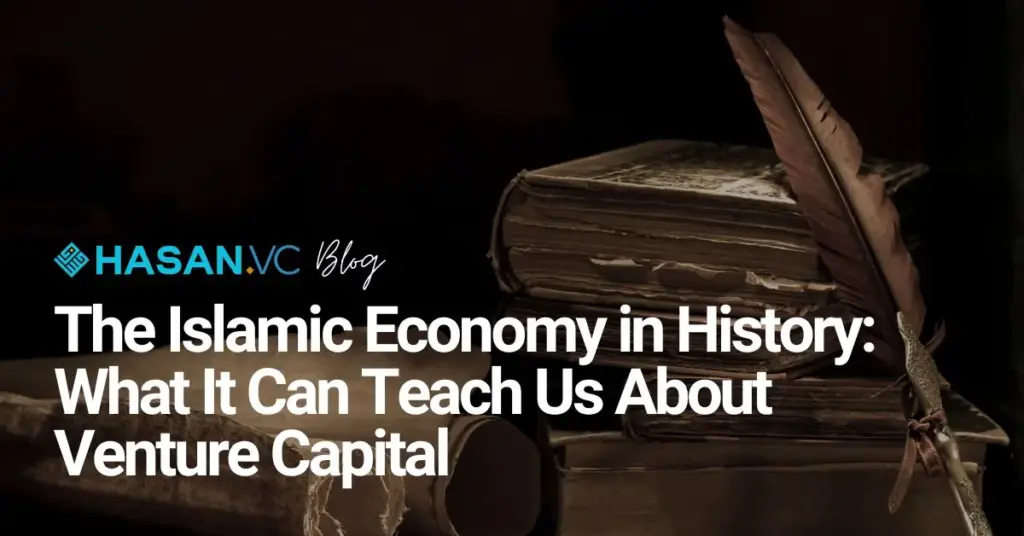
This is what makes the Islamic economy in history particularly relevant to the conversation around venture capital today. Not because Muslims in the past possessed an early version of modern capitalism or venture capital. They did not. Nor is the purpose of looking back to find historical equivalents for every modern financial instrument.
The deeper value lies in something else. Islam established principles governing economic activity that remain relevant even as the circumstances of economic life changed. Markets evolve. New businesses emerge. Different contracts can develop. Technology will transform commerce.
The forms can change.
The principles endure.
That distinction offers a useful way to think about capital, entrepreneurship and venture investing today.
A Commercial World, Not an Economic Blank Slate
The Arabia in which Islam emerged was already commercially active.
Mecca was connected to regional trade networks, and Quraysh merchants participated in caravan commerce. The Prophet Muhammad ﷺ himself had experience in trade before his prophethood. Historical scholarship also identifies forms of commercial partnerships in which capital and entrepreneurial agency could be separated, practices that were subsequently developed within Islamic jurisprudence.

Islam therefore did not arrive to eliminate commerce or replace an economic vacuum with an entirely new system. It did not condemn the pursuit of wealth.
The Qur’an speaks extensively about trade, property, contracts, debts, inheritance and commercial exchange. It permits trade while prohibiting riba (usury or interest), and it prohibits consuming one another’s wealth unjustly while recognizing legitimate trade by mutual consent.
The point was not to eliminate markets, it was to govern them.
That distinction matters.
A market can allocate resources efficiently while still permitting deception. A contract can be legally sophisticated while still producing an unjust outcome. An investment can generate a financial return while contributing little to productive economic activity.
Islamic economic thought therefore places commerce within a broader moral and legal framework.
Profit, ownership and wealth creation are encouraged, with conditions – how wealth is created, exchanged and deployed matters.
Justice, honesty, consent, contractual responsibility, legitimate ownership and avoidance of exploitation are not external considerations added after the economic transaction. They are part of the framework within which the transaction is judged.
Principles, Not Fixed Forms
This is where Islamic commercial law becomes particularly interesting.

Islamic economic thought does not require every legitimate transaction to have existed in precisely the same form in the past. The world of commerce changes. New goods appear, new technologies emerge and new ways of organizing businesses and capital become possible.
A well-known juristic maxim in Islam captures this flexibility:
الأصل في المعاملات الإباحة
Al-aṣl fī al-muʿāmalāt al-ibāḥah — the basic principle concerning transactions is permissibility.
The maxim appears in different formulations within the juristic tradition, and scholars have discussed its scope and evidentiary basis. But its broader significance is important: ordinary commercial transactions are fundamentally open to human arrangement unless a valid basis establishes prohibition.
That means Islamic law does not need to predict every future business model in advance.
Human beings can innovate. They can establish new businesses, create new contractual arrangements, develop new technologies and organize capital in new ways.
The question is not:
“Did Muslims in the past have this exact financial instrument?”
The real question is:
“What is this transaction, economically and legally, and does it conform to the principles governing permissible economic activity?”
This distinction is essential.
A modern startup did not exist in the form we know it today in classical Muslim societies. Neither did a venture capital fund, a preferred equity round, a SAFE or a digital investment platform.
That does not make innovation inherently incompatible with Islamic finance. It means the innovation must be examined according to its substance, contracts, rights, obligations, incentives and economic consequences.
- Is the underlying activity permissible?
- Are the parties genuinely consenting?
- Are ownership rights clear?
- Are contractual obligations understood?
- Is there deception?
- Does the arrangement involve prohibited riba or excessive gharar (uncertainty/ lack of clarity)?
- Are the risks appropriately allocated?
- Does the financial structure support legitimate economic activity?
These questions allow economic innovation without abandoning ethical boundaries. Hence, in this sense, Islamic finance need not be a search for historical replicas. It can be a framework for evaluating the future.
Capital, Ownership and Enterprise
One of the most revealing examples from Islamic commercial history is muḍārabah, also associated with qirāḍ or muqāraḍah in different contexts.
Its basic structure separates two contributions: One party provides capital while another provides entrepreneurial effort and management.

The parties agree how profits will be divided. In the standard structure, financial loss is borne by the capital provider, while the entrepreneur loses the value of the effort invested, unless the loss results from negligence, misconduct or breach of the agreed terms.
Calling muḍārabah “venture capital” would misstate the historical record. There were no venture funds, startup cap tables, preferred shares, or modern corporate governance structures in it, only a contractual institution in which one party supplied capital and another supplied entrepreneurial effort and management.
Still, the historical institution illustrates an important principle: capital and entrepreneurial effort can be different contributions to the same economic enterprise.
That principle remains highly relevant.
Modern venture capital addresses a similar economic problem. If you’re the entrepreneur, you may have the expertise, vision, network, and determination to build a company, just not the capital to do it. If you’re the investor, you may have the capital, just not the time, network, or ability to deploy it effectively yourself.
Venture capital brings these different contributions together.
The investor accepts the uncertainty of the venture in exchange for an ownership interest and exposure to the potential future value of the company. The founder contributes time, expertise, and execution. Both parties are connected to the outcome of the enterprise, although their contributions, rights, risks, and returns may differ depending on the investment structure.
Again, this does not make venture capital automatically Shariah-compliant. Modern investment structures contain complex terms, rights, preferences, and financial arrangements that require careful examination. Equity ownership alone does not settle every Shariah question.
The point is more fundamental. Venture capital raises questions about capital, entrepreneurial effort, ownership, risk, and profit that Islamic commercial jurisprudence has long taken seriously.
- What does each party actually own?
- What has each party contributed, capital or effort?
- What exactly has been promised, and to whom?
- Who absorbs the downside if the venture fails?
- Who shares in the upside if it succeeds?
- What real economic activity stands behind the financial claim?
They are investment questions as much as historical ones.
Risk Is Part of the Enterprise
Venture capital exists because the future is uncertain. The entrepreneur does not know whether customers will adopt the product. The investor does not know whether the company will reach scale. Technology can change, competitors can emerge and assumptions can prove wrong.

The investor commits capital despite this uncertainty because the potential upside can justify the risk.
Islamic commercial principles do not seek to eliminate uncertainty from economic life. Commerce itself necessarily involves uncertainty. What Islamic jurisprudence addresses is gharar: problematic or excessive uncertainty and ambiguity that can undermine the fairness and clarity of a transaction.
That distinction is important. A startup cannot provide certainty about its future, nor should it be expected to. The relevant question is whether the parties understand the nature of the transaction, and whether the uncertainty is an inherent part of legitimate entrepreneurial activity or instead arises from an unfair or excessively ambiguous contractual arrangement.
This creates an important distinction between entrepreneurial risk and problematic contractual uncertainty. As an investor, that distinction is what tells you whether a risk is worth taking, or whether the uncertainty comes from an unfair or poorly structured deal.
The goal is to understand risk, allocate it appropriately, and make sure the financial relationship reflects the underlying economic reality.
Trust Is Part of the Economics
The same principle applies to trust.
The Prophet ﷺ emphasized honesty and disclosure in commercial transactions, warning against concealing defects in goods. The Qur’an repeatedly emphasizes fulfilling contracts and provides detailed guidance concerning financial obligations and their documentation.

These teachings are not merely matters of personal morality. They have economic consequences.
Every investment involves information asymmetry. A founder knows things an investor does not. An investor may possess information or expertise that a founder lacks. A company’s management knows more about the business than many of its shareholders.
Contracts can reduce some of these problems, but they cannot replace the need for trust. That makes amanah (trustworthiness) as much an economic principle as a moral one.
For venture investors, this has practical implications. Due diligence does more than protect the investor: it protects the quality of the investment relationship. Clear documentation does more than offer legal protection: it creates clarity around expectations. Aligned incentives go beyond financial engineering: they can determine whether founders and investors are genuinely building toward the same long-term outcome.
In other words, ethical principles and sound investing do not necessarily compete with one another. Sometimes they reinforce one another.
What Is Capital For?
Perhaps the deeper question is not simply how capital earns a return, but what capital is for.
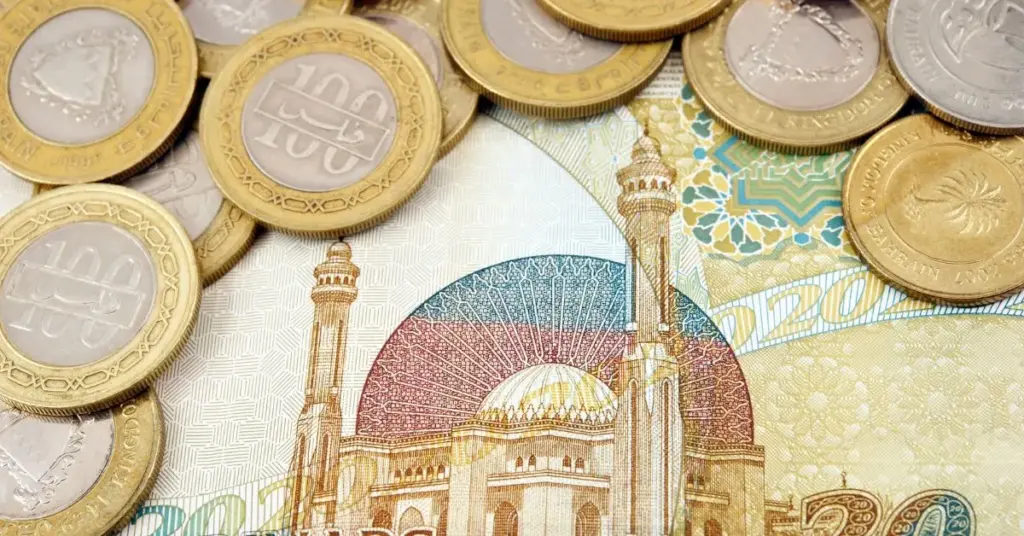
Islam recognizes private ownership and the legitimate pursuit of profit. At the same time, wealth exists within a broader social and ethical order. The Qur’an’s discussion of wealth distribution articulates an important principle: wealth should not merely circulate among the wealthy. As the Qur’an states, wealth is to be distributed “so that it does not merely circulate among the rich among you” (Qur’an 59:7):
…كَيْ لَا يَكُونَ دُولَةً بَيْنَ الْأَغْنِيَاءِ مِنْكُمْ…
Read against modern venture capital, the verse still points toward an important conception of capital: wealth as a means of enabling productive economic activity, not an end detached from it.
That distinction matters for investors.
When capital is deployed into a startup, it can finance engineers, researchers, factories, software, intellectual property, distribution and new products. It can enable people to build something that did not previously exist.
The financial instrument is one thing. The economic activity underneath it is another. And that leads to a question that every capital allocator should take seriously: What exactly is our capital enabling?
Two investments can produce the same financial return while representing very different forms of economic activity. One may finance innovation, employment and useful products. Another may generate returns primarily through financial extraction or the exploitation of information asymmetry.
The return is a financial measurement. It is not, by itself, a complete account of economic value. This is where values-driven investing becomes more than an exercise in screening prohibited industries. It becomes a question of what kind of economy capital helps build.
What This Means for Venture Capital
The relevance of Islamic economic principles to venture capital therefore does not depend on proving that historical Islamic partnerships were equivalent to modern investment structures.

They weren’t, and the relevance lies in the principles underneath them.
Ownership matters.
An investor should understand what it owns and what rights accompany that ownership.
Risk matters.
Entrepreneurial capital is exposed to uncertainty, and financial structures should not obscure who bears which risks.
Contracts matter.
The parties should understand their rights and obligations, with transparency rather than ambiguity at the center of the relationship.
Productive activity matters.
Capital should ultimately be connected to legitimate economic value rather than becoming detached from the enterprise that supposedly generates its return.
Ethical boundaries matter.
Financial innovation can create new possibilities, but innovation does not remove the need to consider whether its structure and substance are permissible.
These principles don’t prescribe a single model of venture capital so much as a framework for thinking about it, which is precisely why the principle of permissibility in muʿāmalāt matters so much.
Islamic finance can look forward instead of searching backward for a historical version of every modern instrument.
Carrying the Principles Forward
This is where the conversation around Islamic venture capital becomes particularly compelling.

The future of Islamic finance does not depend on recreating the economic institutions of another era.
The caravan has become the global supply chain. The merchant has become the founder. The physical marketplace has become the digital platform. Capital that once travelled with a caravan can now cross borders in seconds. The economic environment has transformed. The underlying questions have not.
- Who owns the enterprise?
- Who supplies the capital?
- Who supplies the work?
- Who carries the risk?
- What was disclosed, and what was left unsaid?
- What actually generates the return?
- And what responsibilities ride along with the pursuit of wealth?
The answers will necessarily evolve as economic life evolves. The principles used to evaluate those answers can endure.
Islamic finance offers more than a set of restrictions placed around conventional finance: a framework for thinking about how capital should participate in economic life while leaving room for human creativity and innovation.
For venture capital, that opens an important possibility. Islamic principles do not need to be “modernized” in order to become relevant. The instruments of finance can modernize. The technology can modernize. The business models can modernize.
But principles such as justice, trust, legitimate ownership, contractual responsibility, productive enterprise and ethical limits remain meaningful precisely because the questions they address are not tied to a particular century.
That is the opportunity for Islamic venture capital: to carry its principles forward, not recreate the past.
Why This Matters to HASAN.VC
This is the perspective that makes the intersection of Islamic finance and venture capital worth exploring.
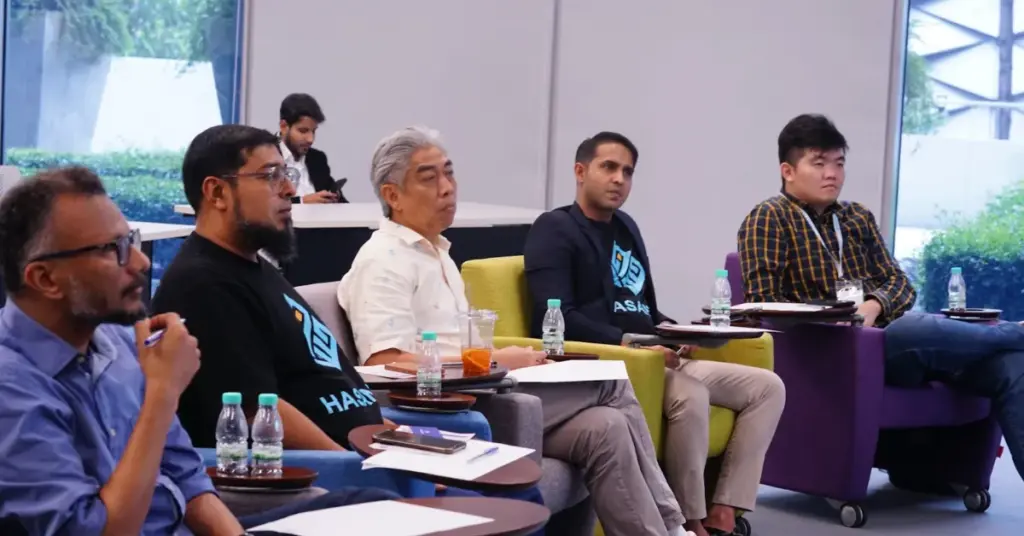
HASAN.VC’s opportunity goes beyond putting a Halal or Islamic label on a conventional venture model. It is about joining a broader conversation on what entrepreneurial capital can look like when investment is weighed through the lenses of ownership, responsibility, productive enterprise and ethical purpose.
For founders, that means building businesses where value creation is more than financial engineering. Take Qara’a (alquran.ai), one of HASAN.VC’s portfolio companies: its distribution partnership with Telkomsel landed during the recent Hajj season, putting a Quran-engagement product in front of exactly the audience primed to use it. That’s capital funding real access, not just manufacturing a return.
For investors, it means considering not only where capital can generate a return, but what that capital enables.
And for the broader ecosystem, it means demonstrating that Islamic principles can engage confidently with entrepreneurship, technology and financial innovation without abandoning their foundations.
Modern finance does not need to resemble the past to stay faithful to it. The task is to build the future without losing sight of the principles that should govern it.
Islamic economic history, then, is more than a record of how Muslims traded centuries ago. It shows how enduring principles were applied to the economic circumstances of their time, and invites us to consider how those same principles might guide ours.
The forms of capital will continue to change. Entrepreneurs will continue to innovate. Markets will continue to evolve. What matters is which principles we carry with us as they do. That is the conversation HASAN.VC exists to advance.
Interested in being part of that conversation?
HASAN.VC is a private, global angel group. It’s people, not an institution, pooling capital behind founders building with these principles in mind. If this way of thinking about capital resonates, explore the HASAN.VC community and the conversations happening inside it.
Click here to learn more about venture investing.
Stay ahead of the queue by joining our mailing list for latest updates on events and investment opportunities.