Having capital is only the beginning of angel investing.
The harder question is what to do with it.
A promising startup can look compelling in a pitch deck and still fail to build a durable business. A strong founder can enter the wrong market. A large market can prove difficult to monetize. A fast-growing company can require far more capital than expected. And an attractive valuation can become much less attractive when the next financing round arrives.
This is what makes early-stage investing different from simply buying a publicly traded security. At the point when an angel investor makes a decision, much of the information that would normally support an investment thesis is incomplete.
For a first-time angel, that can make the process particularly difficult. Where do you find credible opportunities? Which questions should you ask? How do you assess a founder when there is little financial history? How much should you invest? And how do you avoid making every investment decision in isolation?
An angel investor network does not eliminate those problems. What it can do is change the environment in which an investor confronts them.
In 2026, that distinction matters. The venture market is producing strong headline numbers in some areas, particularly around artificial intelligence and very large financings, while capital remains concentrated and conditions differ significantly across companies and stages. At the angel level, the Angel Capital Association’s latest data also points to a more selective market, with reported investment by its member organizations increasing in 2025 while attention shifted toward larger investments and areas such as AI and life sciences.
For an emerging investor, the question is therefore not simply whether there are startups worth investing in. It is whether there is a better way to find, evaluate, understand and participate in those opportunities.
That is where an angel investor network can become useful.
What Is an Angel Investor Network?
An angel investor network is an organized community that connects individual investors with early-stage companies and with other investors.
The exact model varies. Some networks primarily provide education and deal access. Others organize syndicates or investment vehicles. Some focus on particular sectors or geographies, while others are built around a shared investment philosophy.
The common feature is that the investor is no longer operating entirely through their own personal network and knowledge base.
Instead, they become part of an ecosystem in which opportunities, information, relationships and investment experience can be shared.
That does not mean members outsource their investment decisions. A responsible angel remains accountable for understanding an investment, assessing its risks and deciding whether it belongs in their own portfolio.
The network simply gives that decision more context.
For someone investing independently, the process might look like this: discover a company, arrange a conversation, conduct diligence, assess the terms and decide whether to invest.
Inside an established network, the same process can involve additional layers of screening, discussion, specialist knowledge, co-investors and access to people who have evaluated similar companies before.
That difference leads to the first reason to consider joining one.
1. A Network Can Give You Access to Opportunities You Would Not Find Alone
The first challenge for a new angel is often not capital allocation. It is opportunity discovery.
Startup founders do not distribute their fundraising opportunities evenly across the market. Companies are introduced through founders, existing investors, accelerators, advisers, operators, professional networks and other relationships. An investor who has spent twenty years building a technology business may have access to a completely different set of opportunities from an executive who has spent the same twenty years in banking.
This creates an invisible advantage: the quality of an investor’s personal network influences what that investor gets to see.
An angel network can broaden that opportunity set.
The Angel Capital Association’s description of the angel-investing process highlights the role of relationships in generating deal flow. Opportunities can reach angel groups through entrepreneurs, other investors, professional advisers and existing members, while groups can screen opportunities before presenting them to their wider investor base.
That does not mean every opportunity entering a network is attractive. It means the investor may spend less time trying to manufacture deal flow from scratch and more time evaluating opportunities that have already entered an investment ecosystem.
This distinction becomes especially relevant as startup markets become more geographically distributed. A professional based in Kuala Lumpur may have little natural exposure to an early-stage company in Riyadh, Jakarta or Toronto. A network with relationships across those markets can make such opportunities visible without requiring the investor to build an entirely new professional network in each location.
For a beginner, that can be valuable in another way: exposure itself becomes part of the learning process.
Seeing ten different companies raise capital teaches an investor something that reading one pitch deck cannot. Seeing twenty founders approach the same problem teaches even more.
The value of deal flow, in other words, is not simply the number of companies an investor sees. It is the quality and diversity of the opportunities that help the investor develop a view of what deserves attention.
2. A Network Can Help You Develop Investment Judgment
The hardest part of angel investing is rarely learning what a revenue multiple is.
It is learning how to distinguish an attractive story from an attractive investment.
Early-stage companies often have limited historical data. The investor therefore has to evaluate things that cannot be reduced neatly to a spreadsheet: founder-market fit, customer behaviour, market structure, competitive dynamics, speed of learning, capital requirements and the credibility of the company’s path to its next milestone.
That judgment develops through repeated exposure.
An investor who participates in a network may observe how more experienced angels interrogate a pitch, challenge assumptions, compare companies and identify risks. Over time, the investor begins to build their own mental models.
Why is one founder’s lack of experience acceptable while another’s is a major concern? Why can a smaller market sometimes be more attractive than a huge one? When does customer traction represent genuine product-market fit rather than early enthusiasm? What does a sensible financing plan look like for a company that is still pre-revenue?
These are difficult questions to learn from a textbook because context matters.
This is one reason investor communities can be more valuable than a simple database of investment opportunities. The database gives you information. The community gives you the opportunity to observe how other investors interpret it.
Research on business angel co-investment networks has found that access to knowledge through those relationships can matter when investors build portfolios across industries. The evidence does not mean that joining a network guarantees better investment performance. It does, however, support a more modest and useful conclusion: who you invest alongside can affect the information and expertise available to you.
For a first-time angel, that can shorten the distance between being interested in startups and actually understanding how professional investors evaluate them.
3. You Can Bring More Expertise Into the Investment Decision
No angel investor can be an expert in everything.
A single startup may raise questions about technology, regulation, accounting, intellectual property, distribution, customer acquisition, cybersecurity and industry-specific market dynamics.
An investor might be highly experienced in finance but have limited knowledge of healthcare regulation. Another might understand enterprise sales but know very little about fintech. A founder-turned-investor might have exceptional product intuition but less experience with transaction structuring.
A network creates the possibility of combining these perspectives.
This is where the distinction between collective intelligence and collective decision-making becomes important.
The objective should not be for every member to agree simply because everyone else agrees. In fact, constructive disagreement can be one of the most useful features of an investor community.
A technology operator may see a product risk that a financial investor misses. An experienced founder may recognize a hiring problem hidden behind an impressive growth story. Someone familiar with a particular market may question an apparently attractive market-size calculation.
The result is not certain. Early-stage investing does not offer certainty.
The benefit is that the investor has more ways to test an investment thesis before committing capital.
Consider a hypothetical investor evaluating a startup in a sector they have never worked in. Alone, they might spend hours researching the market and still struggle to distinguish industry-specific risks from normal startup uncertainty. Within a network, they may be able to speak with someone who has operated in that sector, another investor who has seen similar companies, and a founder who has experienced the same customer-acquisition problem.
The investment decision remains theirs.
But it is now being made with a broader information set.
That is one of the most practical reasons to join an angel investor network: you do not have to personally possess every piece of expertise required to ask better questions.
4. A Network Can Make Participation in Venture Investing More Practical
Angel investing is not simply about choosing companies. It is also about deciding how much capital, time and attention you can reasonably commit to a portfolio.
This creates a practical challenge for emerging investors.
An individual may have enough capital to make a startup investment but not enough capital—or appetite—to build a large portfolio independently. They may also have a demanding career, family responsibilities or an operating business that limits the amount of time available for sourcing and diligence.
Co-investment and syndication can change that equation.
When several investors participate in an opportunity, they can share the capital requirement and, depending on the structure, benefit from the relationships and expertise that each participant brings.
Research on angel investing has examined the relationship between co-investment networks, diversification and knowledge access. Other research has looked specifically at syndication in cross-border angel investing, where local relationships and knowledge can be particularly important.
The important point is not that syndication automatically produces a better portfolio.
It is that collective participation can make access to early-stage investing more practical for individuals who do not want to operate as standalone venture funds.
HASAN.VC’s model provides a useful example of this approach.
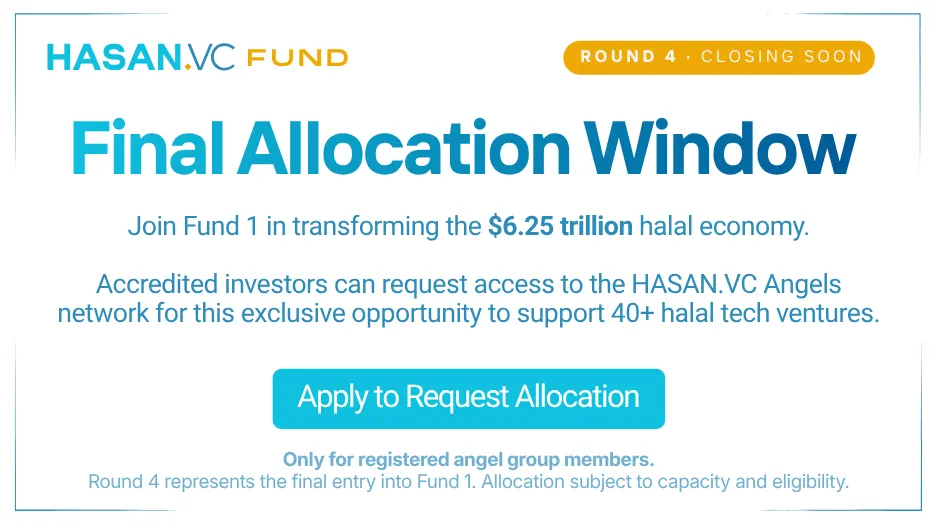
The current HASAN.VC model connects a private angel community with a people-powered venture capital fund. The Fund is funded by angel investors from the community, while HASAN.VC’s accelerator identifies and supports early-stage companies that can become investment opportunities within the broader ecosystem.
HASAN.VC’s community is a private network spanning multiple markets including Singapore, Malaysia, Canada and the GCC, with members able to participate in the Fund and, where applicable, direct investments into alumni startups.
For an investor, this creates a different proposition from simply receiving occasional startup pitches.
The investor can participate in an ecosystem where capital, startup sourcing, founder development and investor relationships are connected.
That is the significance of a people-powered model.
5. You Can Invest According to a Philosophy, Not Just a Pitch
There is one final question that is easy to overlook when discussing angel networks:
What do you actually want your capital to help build?
Investment decisions are often discussed in terms of valuation, growth, market size and potential returns. Those things matter. But investors also differ in the kinds of businesses they want to support and the principles they want reflected in their investment decisions.
For some investors, that includes Shariah compliance. For others, it may include ethical screening, social impact, sustainability or a preference for businesses that create tangible economic value.
An investment network can provide something that a conventional deal marketplace cannot: a shared investment philosophy.
This is particularly relevant to HASAN.VC.
HASAN.VC is a people-powered venture capital fund dedicated to investing in companies driven by ethics and purpose. The firm invests in ethical, halal technology startups and its philosophy is investing in people, not simply products.
Its Camel philosophy provides another layer to that approach.
Rather than treating the unicorn model—rapid growth, aggressive capital deployment and ever-higher valuations—as the only definition of startup success, HASAN.VC emphasizes resilient businesses that can endure. HASAN.VC’s camel mindset gives a preference for startups with a sustainable business model, while allowing room for other approaches where a company has unique value to society.
For an investor, that changes the conversation.
The question becomes not simply:
“Could this company become very valuable?”
but also:
“Is this a company I believe is worth helping build?”
This does not replace financial discipline with values. Rather, it broadens the investment framework: commercial potential, resilience and return prospects remain fundamental, while the nature of the business and the value it creates also become part of the decision. For investors seeking halal or values-aligned opportunities, that distinction can be particularly important.
The principle is broader than any single faith or investment philosophy. Capital does more than seek a return; it also enables particular businesses, products and economic activity to grow. An investor community built around shared principles can bring that consideration into the investment process from the outset, rather than treating it as an afterthought.
What an Angel Investor Network Does Not Do
Joining an angel investor network does not make startup investing safe.
Early-stage companies can fail completely. Private investments can be illiquid, valuations can be uncertain, future financing can dilute existing shareholders, and investment outcomes may take years to materialize. Investors can also lose some or all of the capital they commit.
A network does not remove these risks.
Nor does a respected investor’s participation make an investment automatically suitable for everyone else. Networks can experience groupthink, members can disagree, and screening processes can still miss important risks.
That is why prospective members should evaluate the network itself.
Before joining, ask how opportunities are sourced, what screening takes place, how diligence is conducted, who makes investment decisions, what information members receive, how conflicts are handled, what fees or costs apply, and what the investor is actually receiving in return for membership.
A good angel network should make the investment process more transparent, not more opaque.
What This Means for an Investor Considering HASAN.VC
HASAN.VC brings together an angel investor community, an accelerator that identifies and nurtures startups, and a venture capital fund backed by the angel community. This people-powered model connects capital, startup development and investor participation within one ecosystem.
For investors, this can mean access to a curated portfolio rather than dependence on individual startup opportunities. Companies go through HASAN.VC’s sourcing, screening and investment process, while investors can participate through the Fund and, where applicable, direct investments in selected startups. The angel community also provides opportunities to exchange knowledge, engage with founders and invest alongside other investors.
Ultimately, the model combines curated access, portfolio exposure, collective knowledge and a defined investment philosophy—giving investors a structured way to participate in early-stage investing without having to build the entire process independently.
Is Angel Investing Right for You?
An angel investor network can be particularly useful for someone who wants exposure to startup investing but does not want to build an entire venture-investing infrastructure alone.
That could be a first-time investor who wants to learn before making a significant allocation, an entrepreneur who understands startups but wants broader deal flow, an executive with industry expertise who wants to contribute that knowledge to investments, or an experienced angel looking for new opportunities and a values-aligned investor community.
But the decision to invest should remain personal.
Angel investing should be approached with capital that an investor can afford to have tied up for an extended period and potentially lose. The appropriate allocation depends on an individual’s financial circumstances, objectives, risk tolerance and investment strategy.
The network should improve the process around the decision—not make the decision for the investor.
The Advantage Is Not the Network. It Is What the Network Enables.
The best reason to join an angel investor network is not that it promises better deals.
It is that serious early-stage investing is difficult to do well in isolation.
A network can give an investor access to opportunities that would otherwise remain outside their personal circle. It can expose them to different ways of evaluating founders and markets. It can bring specialist knowledge into diligence, make co-investment more practical and provide a community in which investment judgment develops over time.
And for investors who care about what their capital supports, the right network can add another dimension: a shared philosophy about the kind of companies worth building and backing.
That is ultimately what makes the people-powered model interesting.
Capital may start the investment.
But judgment, relationships, discipline and purpose shape what that capital becomes.
For investors who want to explore early-stage investing within a private community focused on halal, ethical and purpose-driven venture capital, the HASAN.VC Angels Network is the natural place to learn more.
Learn more: https://hasan.vc/angels/
Stay ahead of the queue by joining our mailing list for latest updates on events and investment opportunities.