Every startup you’ve heard of that raised venture money got it from a fund. And every fund got its money from someone else first.
That someone is the LP.
If you’re weighing your first commitment to a venture fund, the term shows up on page one of every document you’ll read. Here’s what it means in practice: what an LP does, what you pay, what you get back, how long your money is tied up, and why the structure sits closer to classical Islamic partnership than most people expect.
What is an LP in venture capital?
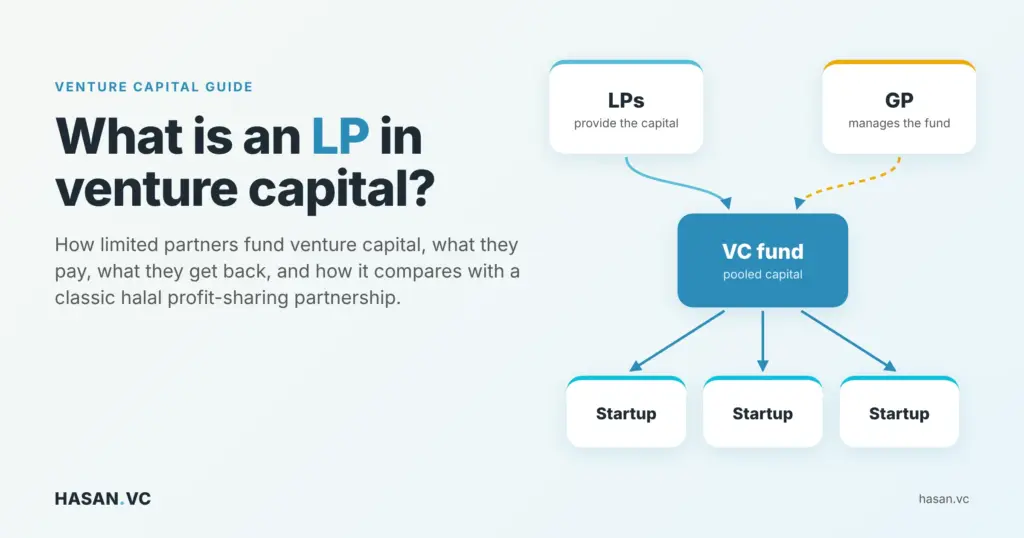
A limited partner (LP) is an investor who puts capital into a venture capital fund but doesn’t run it. So when people ask what is LP in venture capital, the short answer is: the money behind the fund.
The fund itself is managed by the general partner (GP). That’s the individuals who find startups, decide where to invest, sit on the boards of investees (in most cases) and eventually sell the stakes they acquired to return capital and profits to LPs.
“Limited” refers to your liability. As an LP, the most you can lose is the amount you committed.
In short: the LP brings the capital, the GP brings the judgment and the work.
What are LPs in venture capital, and who are they?
Large funds draw on pension funds, university endowments, sovereign wealth funds, insurers, foundations and family offices. Smaller and emerging funds tend to lean more on high-net-worth individuals, angel investors and family offices. In the Muslim world, Waqf funds are increasingly part of that mix.
Most jurisdictions limit who can invest in a private fund, usually to investors who meet a wealth, income or professional test. Singapore, Malaysia, the UK and the Gulf each set their own criteria, so check the rules where you live.
How does an LP invest and how do VCs work?
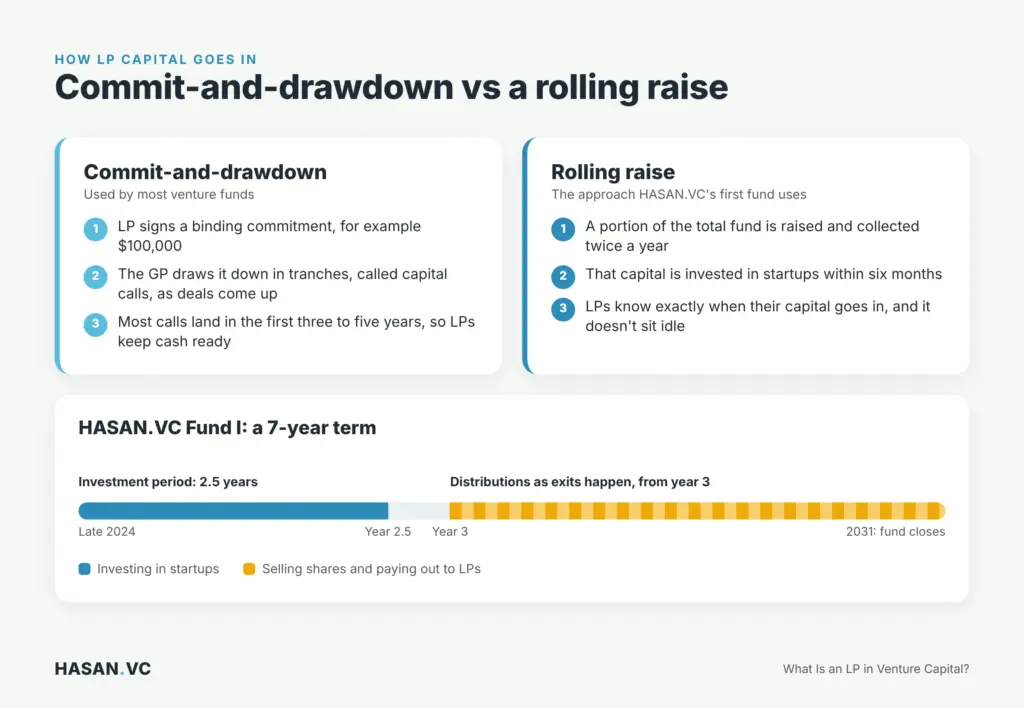
Most venture funds use a commit-and-drawdown model. You sign a binding commitment, say $100,000, and the GP draws it down in tranches called capital calls as deals come up. Most of those calls land in the first three to five years, known as the investment period, so you need the cash ready whenever a call arrives. HASAN.VC adopts a 2.5-years investment period for our first fund, meaning we make all our investments in this initial period.
Some funds, especially many smaller funds, work differently. They secure commitments and collect LP commitments at the same time, sometimes over several tranches, rather than drawing down committed capital as deals appear.
HASAN.VC’s first fund uses such a ‘rolling raise’approach. We raise and collect a portion of our total fund twice a year, then deploy this capital (invest in startups) within six months. LPs know exactly when their capital goes in, and the money goes to work quickly. This gives more certainty to our LPs and GPs, making the process organised and structured. Importantly, money does not sit idle in the fund as they are invested and put to work almost immediately.
Whichever model a fund uses, the fund then runs for 7 to 10 years (and sometimes even longer) while startups grow and exit through secondary share sales, acquisitions or public listings. VC is truly patient risk capital. HASAN.VC’s fund has a 7-year term which started in late 2024, meaning that our fund work on selling the shares we own all the way till our fund closure in 2031. Distributions reach LPs as exits happen, giving investors payouts on an ad-hoc basis.
While this will provide some early cashflow to our LPs, the basic principle is to plan for and expect investments into VCs to be generally illiquidity.
What does an LP pay, and what does an LP get?
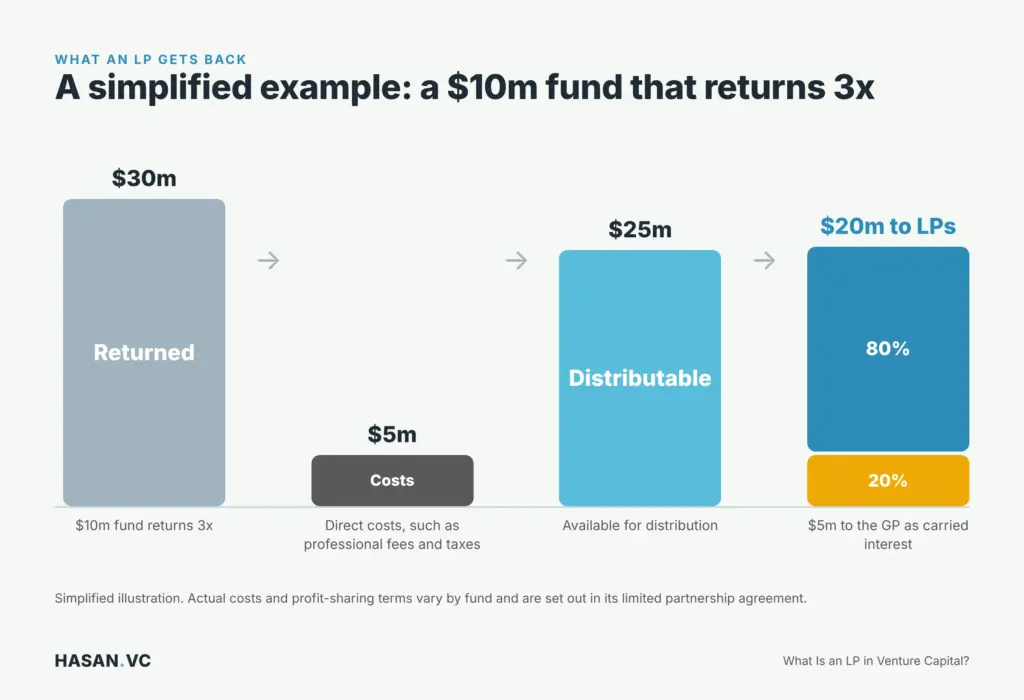
Most funds use some version of “2 and 20” in terms of fees:
- Management fee: around 2% a year of committed capital. It pays for the team and the running of the fund.
- Carried interest (“carry”): 20% of the fund’s profits or exit proceeds go to the GP.
Here’s a simplified example. A $10m fund returns 3x, so $30m comes back. There will be some direct costs deducted such as professional fees and any taxes, and the remainder is distributed. Assuming $25m is available for distribution, 80% of this $20m goes to LPs and $5m goes to the GP as carry.
GPs usually invest alongside you, too. Carta’s 2025 Fund Economics Report, built on data from about 2,000 private funds, found the median venture GP commits 1.7% of the fund from its own pocket.
What rights does an LP have?
You get regular reporting, a share of distributions in proportion to your commitment, and the protections written into the limited partnership agreement (LPA), the contract that governs the fund. Larger LPs sometimes sit on an advisory committee that reviews conflicts of interest.
What you don’t get is a voice or vote on which startups the fund backs. That’s by design. You’re backing the GP’s judgment, so choosing the GP is the biggest decision you make.
LP vs GP vs venture partner: who does what?
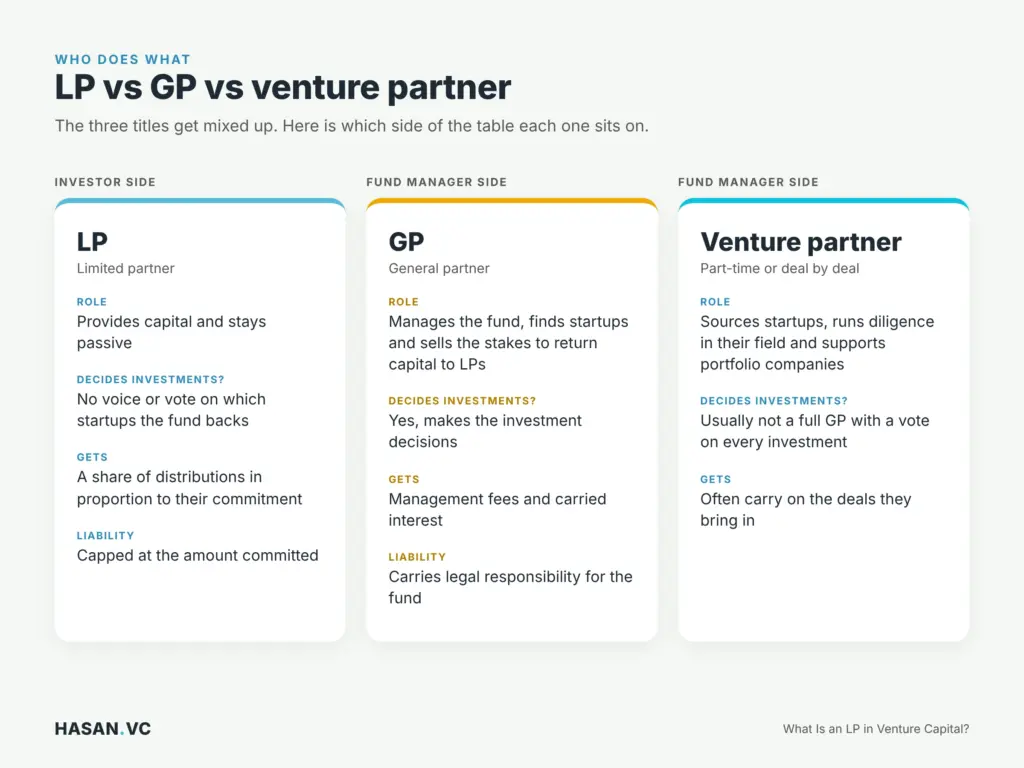
The three titles get mixed up, especially in search results.
- LP: provides capital, stays passive, liability capped at the commitment.
- GP: manages the fund, makes the investment decisions, earns fees and carry, and carries legal responsibility for the fund.
- Venture partner: an experienced operator, founder or investor who works with a VC firm part-time or deal by deal. They source startups, run diligence in their field and support portfolio companies. They’re often paid through carry on deals they bring in, and usually aren’t full GPs with a vote on every investment.
So if you’re asking what is a venture partner, they sit on the fund manager’s side of the table. An LP sits on the investor side.
An old partnership in modern clothes
Islamic finance has a contract that looks a lot like the LP and GP split: muḍārabah, a profit-sharing partnership. One party, the rabb al-māl (owner of the capital), provides the money. The other, the muḍārib (working partner), provides the skill and labour.
Profits are shared at a ratio agreed upfront. If the venture loses money, the capital provider bears the financial loss and the manager loses their time and effort, unless the loss came from the manager’s negligence or a breach of the agreed terms. AAOIFI, the standard-setting body for Islamic finance, sets out the contract in its Shariah Standard No. 13.
The logic carries over. Neither side is promised a guaranteed return. The person with the capital and the person with the expertise share the outcome of real, productive work, which is what a well-run venture fund asks of its LPs and GPs.
The match isn’t perfect. A fixed management fee, for example, has no direct equivalent in classical muḍārabah. That’s one reason Shariah-compliant funds put their fee and profit-share terms in front of a Shariah adviser. If you’re evaluating a fund on those grounds, ask to see that review.
Questions to ask before you become an LP
- Who are the GPs, and what is their track record?
- What are the fees and the carry?
- How long is the fund term, and who decides on extensions?
- For a Shariah-compliant fund: who reviewed the structure, and what screens apply to investments?
Importantly: Does the focus and objective of the fund align with your own?
Where to go from here
At HASAN.VC, our fund is backed by angels, family offices and Waqf funds from across the world, and we invest in startups that come through our virtual accelerator. If you want to understand how a values-driven fund puts the LP model to work, our Venture Capital Fundamentals course is a good place to start.
Capital and entrepreneurship, sharing the outcome. That idea is far older than venture capital.
FAQ block (for FAQPage schema)
What is an LP in venture capital?
An LP, or limited partner, is an investor who provides capital to a venture capital fund but doesn’t manage it. The GP, or general partner runs the fund, and the LP’s liability is limited to the amount committed.
Can an individual be an LP?
Yes, if they meet the investor eligibility rules where they live. Most jurisdictions limit private fund investment to investors who pass a wealth, income or professional test.
How long is an LP’s money tied up?
A typical venture fund runs for 7 to 10 years. LPs either fund their commitment through capital calls over the first few years or pay in directly, sometimes in tranches, and receive distributions as portfolio companies exit. HASAN.VC’s first fund gives distributions from the sale of its shares in startups starting from year 3.
What is a venture partner?
A venture partner is an experienced operator or investor who works with a VC firm part-time or deal by deal, sourcing and supporting startups. They sit on the fund manager’s side.
Stay ahead of the queue by joining our mailing list for latest updates on events and investment opportunities.