We studied how a sample of 11,432 people in North America looked for halal finance. What they did says more about the Islamic fintech opportunity than what the industry tends to talk about.
Islamic finance has spent decades building supply: banks, funds, sukuk, home financing and now a wave of apps. Most conversations about the sector start there, with what is being built and who is funding it.
I want to start at the other end, with the customer. HalalWallet is a comparison and education platform for halal finance, now available in 14 countries. Earlier this year we took a sample of 11,432 people in North America who used it and studied their behavior closely. We tracked what they searched for, what they read, which providers they clicked and what they told our tools about their own money.
This is not a representative sample of Muslims. It is something more useful for anyone building in this space: the behavior of people actively trying to solve a halal money problem right now. Here is what they showed us, and what I think it means for founders and investors in Southeast Asia.
They go looking on their own
We have never run an ad. More than half of the people in our sample (6,406 of 11,432) arrived by typing a question into a search engine. Most of the rest came back directly or found us through social media.
A growing share of the questions now go to AI first. AI tools have pulled HalalWallet’s answers more than 80,000 times a month. People are asking chatbots how a murabaha differs from a mortgage, or whether an ETF is Shariah-compliant, long before they speak to a bank.
And once they find answers, they act on them:
- About 1 in 5 visitors (2,261 people) clicked through to at least one provider.
- About 1 in 3 of those compared two or more providers.
- 21% came back for a second visit during the sample period.
- Of the 1,247 readers we could track, 70% read past three-quarters of an article.
This is not casual browsing. It is research before a decision. If your product’s explanation is not the one that shows up in that search bar or chat window, someone else’s is.
They want to invest, and they want it handled
When visitors told us what they came to solve, investing came first at 35.6%, ahead of home financing at 18.4% and car financing at 17.8%. That surprised us. Many of North America’s best-known Islamic finance providers are home financing companies, yet demand for investing is about twice as large.
The smaller group who used our investing tools gave a consistent picture of the investor they want to be.
- 53% want strict AAOIFI screening.
- 81% want balanced or conservative risk.
- 83% want a hands-off approach or only partial control.
- In our investing quiz, managed halal portfolios and sukuk tied for first at 36.5% each. Active stock-picking came in at 7.7%.
They are also early in their financial lives. 67% rent rather than own. 65% would start investing with less than $5,000. Two-thirds carry no interest-bearing debt at all. And of the people who completed our self-assessment, not one had an Islamic (faraid) will.
I think this reflects a generational shift. Many first-generation immigrants planned to go home one day, so they sent money back and avoided Western finance altogether. Their children decided this is home and built here, with no playbook. Their grandchildren know nothing else and want everything their peers have, halal. That youngest group has ambition but no brakes, and the data says they know it: they do not want to become traders. They want someone they trust to tell them what to do and then handle it.
Southeast Asia has the access, and still has the doubt
In North America, the main barrier is access. People have to go looking for halal options, which is why they show up in search. Southeast Asia starts from the opposite place.
In a 2024 Mambu study of Muslims aged 16 to 40, 77% of young Malaysians and 65% of young Indonesians said they use Islamic banking, compared with 31% across the study’s other markets. Yet 43% of Indonesian respondents doubted that banks fully follow Shariah principles.
BCG’s January 2026 report on Indonesia tells a similar story. Sharia finance is about 7% of Indonesian banking assets, against 32% in Malaysia. Its survey of 5,189 Indonesians found that the most observant customers doubt whether products are authentic, while digital-first customers find the apps clunky and the products thin.
Put our data next to theirs and the same thing is missing. Our users want strict screening before they trust a product. Indonesian customers who already have access still question whether it is really compliant. Access alone does not create confidence.
I am describing North America, and readers here know Southeast Asia far better than I do. But if the pattern holds, the next wave of value in Islamic finance will not come from launching more products. It will come from making consumers confident in the ones that exist.
Where I would build: the confidence layer
Every consumer we see is asking three questions. Is it really halal? Do I understand it? Is it right for me? Whoever answers those questions owns the customer relationship, whoever ends up holding the money.
1.Trust. Customers need an independent way to check whether a product is compliant, and why. That means clear screening standards, named scholars and plain-language explanations, product by product. In both regions, doubt is the brake on adoption.
2.Literacy. People are already teaching themselves, through search and AI. Education has to live where those questions get asked. The provider whose explanation the AI quotes has a head start before the customer ever opens an app.
3.Guidance. Once people trust a product and understand it, most do not want to manage it themselves. Managed, strictly screened products that a first-time investor can start with will meet the demand we see far better than another trading app.
One practical lesson on where to start: zakat is the widest door into a customer’s finances. Among people who used our zakat calculator, 19% went on to look at investing in the same visit, 17% at banking, 12% at home financing and 10% at estate planning. A question about an obligation turns into a review of everything.
The full data behind this piece is in our American Muslim Money Report.
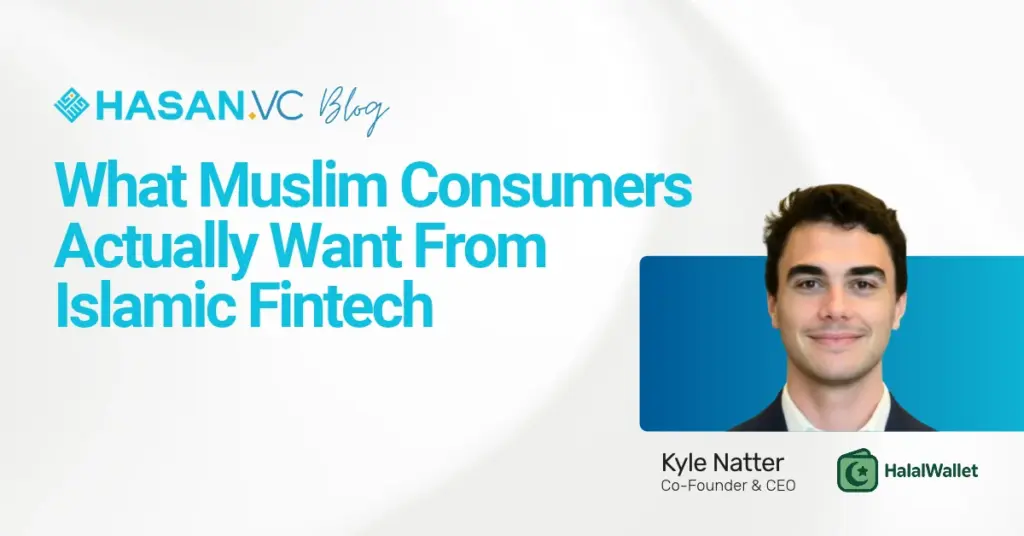
Kyle Natter is co-founder and CEO of HalalWallet, which helps Muslims in 14 countries compare and understand halal financial products.
Stay ahead of the queue by joining our mailing list for latest updates on events and investment opportunities.